
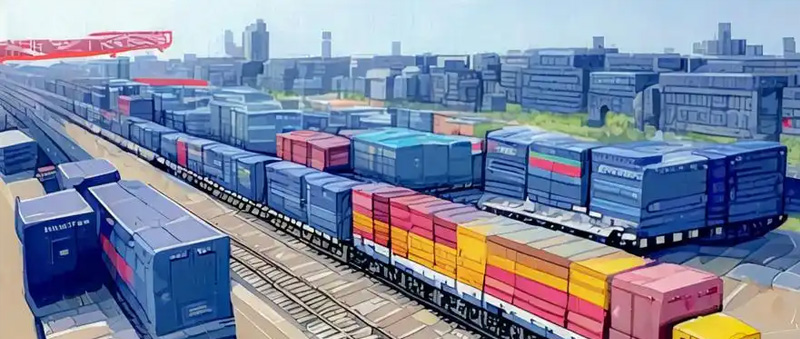
Railway Logistics is a network economy that relies on the collection of railway points and lines, leverages the characteristics of infrastructure and production operations, connects supply and demand entities, and organically combines functions such as transportation, storage, loading and unloading, handling, packaging, circulation processing, distribution, and information processing based on railway resource allocation and optimization conditions. It is the process of planning, implementing, and controlling the physical flow of goods from the supply location to the receiving location.
Compared with modern logistics enterprises, the railway freight forwarding industry still has the following gaps.
Firstly, modern logistics enterprises generally provide comprehensive services to users, while railway transportation agency enterprises only provide railway transportation agency services. In terms of service scope and quality, railway transportation agency enterprises find it difficult to compete with modern logistics enterprises.
Secondly, large modern logistics enterprises generally have gathering and distribution nodes around the world, making it easy to choose transportation tools. However, railway transportation agencies have relatively single transportation tools, which obviously lack flexibility in their operations.
Thirdly, modern logistics enterprises have established fully functional and socially oriented e-commerce networks to achieve rapid transmission of various information and efficient and accurate intelligence activities. However, railway transportation agency enterprises are still far from meeting the needs in terms of information construction.